Monday, July 11, 2016

Let's Explore the Wilderness Together!

Today is a special day, and it's not just because it's free Slurpee day at 7/11.   July 11, 2016, the Monte L. Bean Life Science museum is pleased to present this year's Junior Naturalist Camp!  This program is made possible in conjunction with our partner, Thanksgiving Point Institute.  Designed for 4th-6th graders, this program helps young explorers discover nature and participate in collecting, recording, preparing, identifying, and sharing.  Held this week from 9 am to 3 pm, our young scientists will be able to pin bugs, tour collections, and develop hypotheses of their own.

Though this year's session is sold out, this isn't a one-time deal; we can't wait to see you next year!
With this personal, hands-on experience just down the road from you museum-goers, it's pretty dumb not to sign your children up.  It's not every day they get to have a chat with a museum director - or two.

Thursday, July 7, 2016

Wildlife Adventures: Well Ain't That the Bee's Knees!

We had a ton of fun learning about bees and how important they are during The Bees Knees week of Wildlife Adventures! On Tuesday, we all got together to learn about different kinds of bees, how honey is made, and how bees help give humans the food they need to survive. We learned what an insect is, and saw the difference between an insect and a non-insect by meeting Gunther the Madagascar Hissing Cockroach and Emma the Chilean Rose-Hair Tarantula! We also crafted together a game using pompoms, cups and glitter. We had a fun time designing our own bees!
On Thursday, we explored Utah Central Gardens in Orem, where we looked for different species of bees among the flowers. We saw honey bees, American bumble bees, tri-colored bumble bees, and even some mason and orchard bees! We also got a great tour of the gardens, teaching us about water conservation and some of the plants.
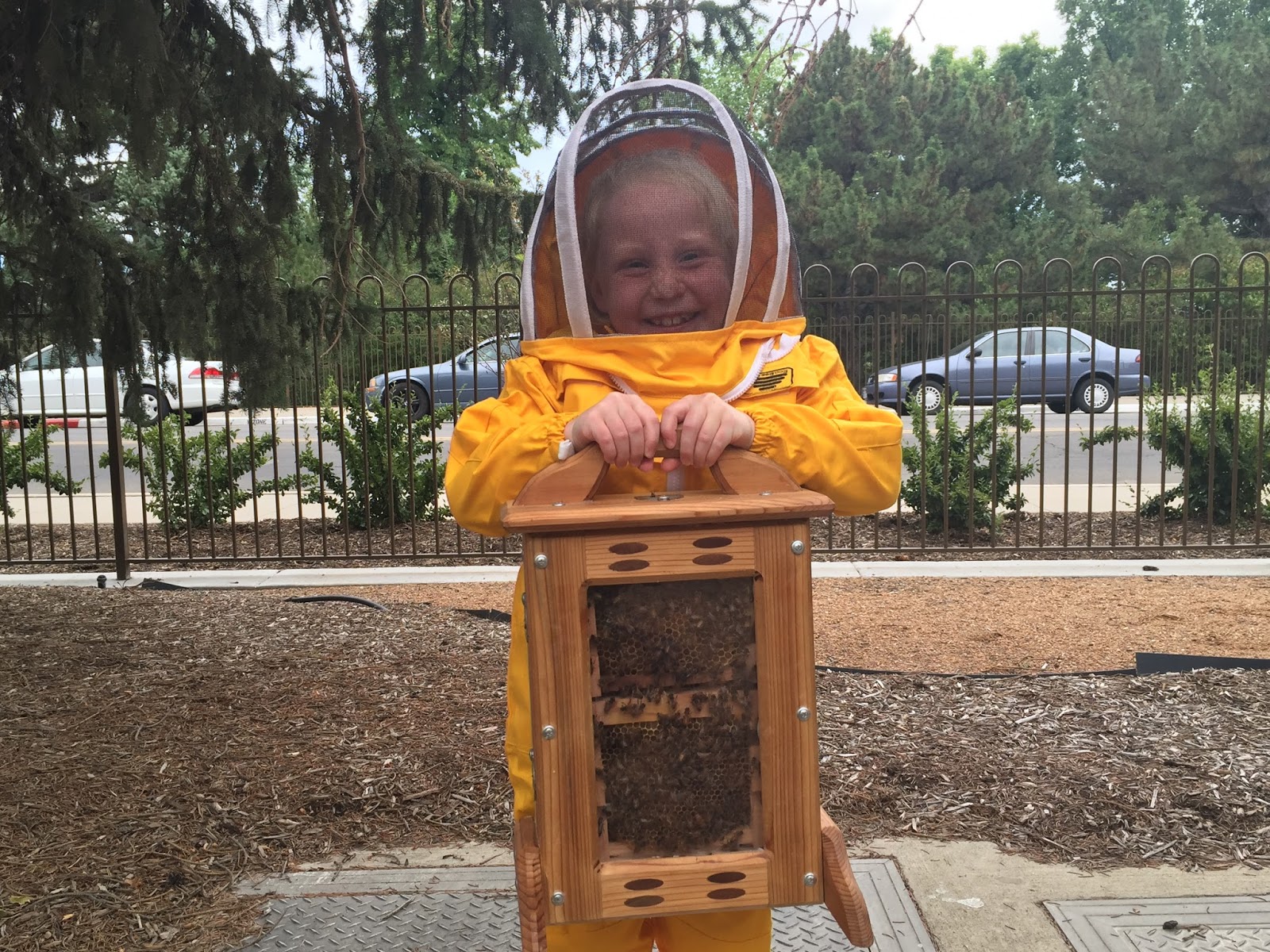
After wearing ourselves out at the gardens, we came back to the Bean Museum, where Albert from Wasatch Honey was waiting. He had a great presentation to teach us more about beekeeping, and he even brought with him an observation hive with real bees! He brought us honey on the comb for us to taste, and all the kiddos got to try on a bee suit. What an experience!
Both days we had a lot of fun and games and learning, and can't wait for next year! 
Join us next week for the next edition of Wildlife Adventures!

Monday, June 27, 2016

ROCK ON

Wildlife adventures rocked this week...literally. Our group of adventurers learned all about who studies rocks, what rocks are made of, and the rock cycle through numerous fun activities.  Our kids were able to make their own metamorphic, sedimentary, and igneous rocks out of crayon shavings to demonstrate how the three rock types are formed. And even though it's the middle of June, we were able to experience our very own Easter egg hunt! Each hidden egg had a rock in it, so after all the eggs were  collected, the group used their new knowledge about rocks to guess what type of rock formation it was. 

On Thursday, our young explorers took a field trip to three different locations: the Eyring Science Center, the Museum of Paleontology, and Rock Canyon. At the science center, the group learned more about all of the rocks on display and was able to play with the exhibits. We also learned all about how fossils are formed between rocks at the Museum of Paleontology. Finally, we took a hike up rock canyon to learn about the importance of weathering and erosion in canyon formation. 


After such a fun week, there is only one thing to say…geology rocks!

Monday, June 20, 2016

Wildlife Adventures: Water Wildlife Edition

The Monte L. Bean Life Science Museum's annual Wildlife Adventures summer program kicked off this week with Water Wildlife!  Classes began Tuesday when our young naturalists learned about the wetlands of Utah and why they are an important part of our ecosystems, specifically identifying what plants and animals are native to Utah and why they are found there.  Additionally, they discussed how wetlands are critical in filtering the thousands of gallons of water that run through their systems daily. But enough talk - after our discussion, our young scientists were able to put their knowledge to the test to build their own wetlands to see who could filter the cleanest water!  It was a day filled of laughter, smiles...and a couple of wet shirts.  
On Thursday, our educators and kids explored the wetlands found in our own backyard. After travelling to Cascade Springs and Bridal Veil Falls, our young naturalists were able to experience first hand what a wetland looks, smells, feels and sounds like (but no worries, we didn't do any tasting).  As we looked at how well Cascade Springs naturally filters the water, a child exclaimed, "Wow!  I can't believe how wetlands can keep the water so clean and clear!"  The kids were then able to wade in the shallow waters at the edge of Bridal Veil Falls and feel the cold temperatures from natural springs.  Not only did our young scientists explore the water, they were able to identify various Utah water wildlife like backswimmers, turkey vultures, butterflies, squirrels, and plant life.


We can't wait for you to join us this week with our next edition of Wildlife Adventures: Rock On!

Tuesday, June 14, 2016

Wanna visit the museum...but just can't find the time?


No worries.  Thanks to Lemonade Stand, there is no need to look like those angry wolves we lovingly let hang out upstairs.  With their marketing expertise and newly completed virtual reality tour of the Monte. L Bean Science museum, which can be accessed at the end of this post, you don't even need to come in to see all of the cool stuff we have to offer! (Except...you do.  Because you can't touch anything through a computer screen.  Or interact with anyone.)  This 360 degree electronic adventure features an overhead "dollhouse" view as well as an on-foot zooming option, creating the effect that you are walking right through the museum from your own home!  It's pretty neat to check out the renovations if you haven't been for a while, and if you're honest with yourself, pretty tempting to come in...

But enough talk.  Check it out for yourself:


Or he'll be out to get you.


Monday, June 13, 2016

Monte L. Bean in Wildlife Adventures: Water Edition


Are your children a little on the bored side yet?  School's been out for a couple of weeks now, and their energy is slowly declining...  We'd love to help solve that problem.

Starting next week, the Bean Museum is proud to present the continuation of our very popular Wildlife Adventures!  The Wildlife Adventures education program is ran by our museum educators, targeting children ages 6-12 and their specific interests.  Each week, centralized around a theme, consists of a day of class in the museum (Tuesday 12-2) and a field trip (Thursday 12-4). Themes and field trips are as follows:

WEEK   DATES       THEME          FIELD TRIP
Week 1 June 14 and 16Water WildlifeUtah Lake
Week 2June 21 and 23Rock OnRock Canyon
Week 3June 28 and 30The Bees KneesLocal beekeeper
Week 4July 12 and 14Feathered FriendsTracy Aviary
Week 5 July 19 and 21Reptile RetreatThanksgiving Point
Week 6July 26 and 28Animal OccupationsHogle Zoo
Week 7Aug 2 and 4Cave CrawlersTimp Cave


 You can fill out the form here to register your child, or call 801-422-6698 for more information.  Spots fill quickly, so register today!  Cost is $35 per child per week.  Refunds, excluding a $4.00 processing fee, are available prior to one week before the assigned starting date.


Monday, June 6, 2016

WHOOOO Can tell me what renovations have been happening with our birds?

So friends.  I don't know how long it's been since you've dropped into the museum, but if it's been a while, it's about time you plan a little trip.  Quite a bit of renovation has just been completed, and the Fred and Sue Morris Bird Gallery's recent makeover is looking good.  From this...


to....HA!  You'll just have to come in and take a look for yourself.
In honor of our exciting changes, this week's animal spotlight is the lesser flamingo, which is given a stunning central position in the restructured exhibit. Weighing in at about 4 pounds and a 36 inches, these animals are one of the smallest and brightest flamingos.  Interestingly, flamingos are not born with their beautiful pink plumage.  Their color comes from carotenoid pigments extracted from their diet (which, in fact, colors tree leaves as well.)  Both male and female flamingos "nurse" their young, in that both provide a type of milk called crop milk.  Lesser flamingos are thought to be the most numerous and live in the largest flocks.

For more information about this gorgeous animal, come check out the updated exhibit!  It won't leave you hanging, like I've so rudely done...